
CRISPR Delivery Systems 2026: The Foundational Guide to Viral and Non-Viral Methods
Compare viral vs. non-viral CRISPR delivery systems in 2026. This guide details safety, efficiency, and FDA-compliant selection strategies for gene therapy development.
Quick Answer: The biggest constraint on CRISPR therapies in 2026 isn't the editing tool — it's getting that tool into the right cells safely. Viral vectors (AAV, lentivirus) deliver it with the highest efficiency but carry immune-response risk and are expensive to manufacture. Non-viral platforms (LNPs, extracellular vesicles) are safer and more scalable but still lag on efficiency and face the "endosomal escape" problem. Your choice depends on target tissue, required duration of effect, and how much existing regulatory/manufacturing data you can build on.
 [IMAGE: CRISPR-Cas9 gene editing mechanism diagram]
source: BioRender Science
[IMAGE: CRISPR-Cas9 gene editing mechanism diagram]
source: BioRender ScienceThe Delivery Bottleneck: Why Choose One Over the Other?
The primary challenge in CRISPR-based medicine in 2026 is no longer the editing machinery itself, but the delivery bottleneck. CRISPR-Cas9 is a highly precise tool, but its therapeutic success depends entirely on reaching the target tissue effectively while minimizing off-target toxicity.
Selecting a delivery system means balancing three things at once:
- Transduction efficiency — the ability to enter the target cell
- Safety profile — immune response risk, off-target activity
- Manufacturing scalability — cost and complexity of producing it at scale
As of mid-2026, the FDA has formalized pathways to leverage prior knowledge in gene therapy development, making it easier for developers to build on established delivery platforms rather than starting from scratch each time.
Viral Vectors: The Standard for High Efficiency
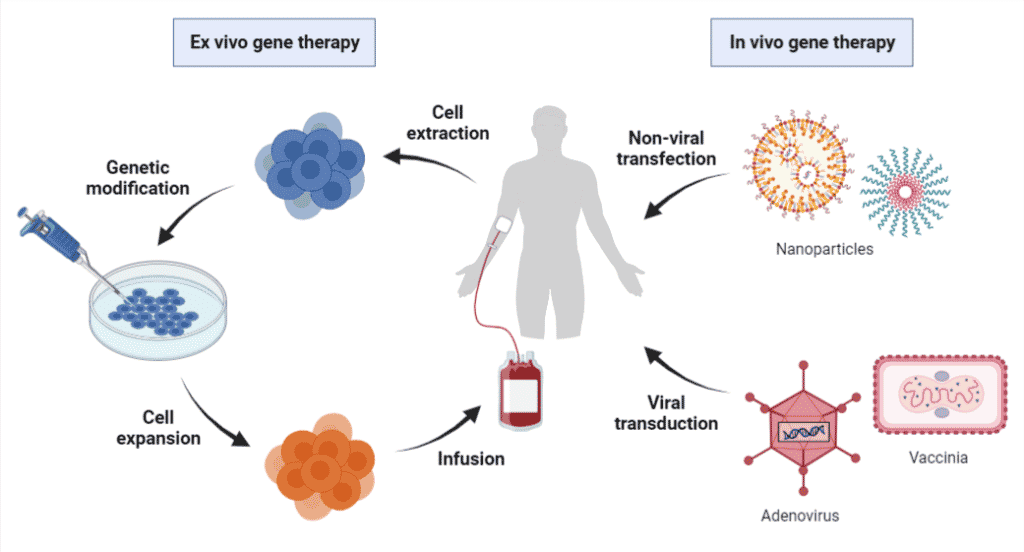
[IMAGE: AAV (adeno-associated virus) vector structure diagram] source: Rapid Novor's "Adeno-Associated Virus Vectors for Gene Therapy Delivery"
Viral vectors — specifically adeno-associated viruses (AAV) and lentiviruses — remain the gold standard for applications requiring high, stable, or long-term gene expression.
| Mechanistic Advantage | By hijacking natural viral infection pathways, these vectors achieve high transduction efficiency even in "difficult-to-transfect" tissues. |
| Clinical Reality | AAV is currently the dominant platform for in vivo applications where episomal (non-integrating) expression is preferred. |
| The Trade-off | Viral manufacturing is complex, costly, and risks immunogenicity — patients may mount immune responses to the vector, often precluding repeat administration. |
📌 Coming soon: A dedicated comparison guide on AAV vs. lentiviral serotypes — "Optimizing AAV Tropism for Neurological Targets." Check back next week.
Non-Viral Platforms: The Scalability Shift
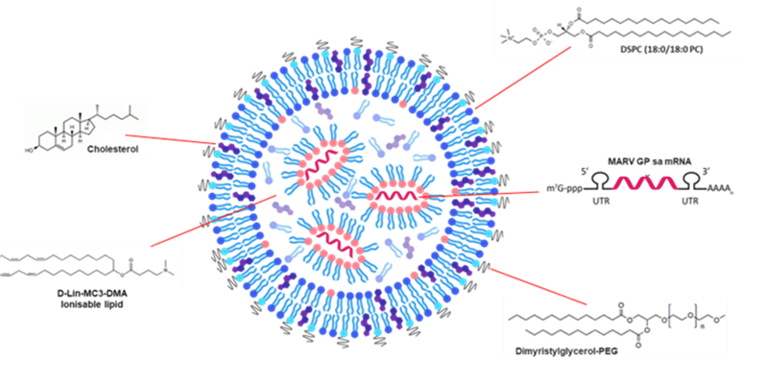
[IMAGE: Lipid nanoparticle (LNP) structure with mRNA cargo] source: Labcorp's "Advancing mRNA Delivery with Nucleic Acid LNPs"
Non-viral technologies — including Lipid Nanoparticles (LNPs) and Extracellular Vesicles (EVs) — are the fastest-growing sector in gene delivery, driven by safety and manufacturing simplicity.
| Safety Profile | No viral proteins means generally lower immunogenicity, allowing potential repeat dosing — a major advantage for chronic disease management. |
| Manufacturing Efficiency | Unlike the biological complexity of viral packaging, non-viral platforms like LNPs are easier to scale under Good Manufacturing Practice (GMP) conditions. |
| Current Limitations | Efficiency remains lower than viral counterparts, and "endosomal escape" — getting the cargo out of the cell's delivery vesicle — remains a core technical challenge. |

[IMAGE: Extracellular vesicle (exosome) drug delivery diagram] Source: the Exosome RNA
At a Glance: Viral vs. Non-Viral
| Feature | Viral Vectors (AAV/LV) | Non-Viral (LNP/EV) |
|---|---|---|
| Efficiency | High (gold standard) | Moderate |
| Immunogenicity | High (risk of pre-existing immunity) | Low (repeat dosing possible) |
| Manufacturing | Complex / costly | Scalable / cost-effective |
| Cargo Capacity | Limited | Flexible |
| Regulatory Status | Established pathways | Evolving rapidly |
Strategic Selection Framework (FDA 2026 Context)
The FDA's June 2026 draft guidance, Leveraging Prior Knowledge in the Development of Human Gene Therapy Products, suggests developers should prioritize platforms where they can build upon existing nonclinical, clinical, and manufacturing knowledge.
When designing your delivery strategy, consider:
- Tissue Tropism — Does the vector naturally target the tissue of interest, or does it require modification?
- Duration of Effect — Is transient expression (non-viral) sufficient to trigger the therapeutic effect, or is stable integration (viral) required?
- Regulatory Benchmarks — Can you use a delivery platform for which safety and CMC (Chemistry, Manufacturing, and Controls) data already exists in the public domain?
🔗 Related read: For a detailed breakdown of the FDA's "Plausible Mechanism Framework" and how it simplifies approval for ultra-rare disease therapies, see: [Navigating the 2026 Regulatory Pathways for CRISPR]
FAQ: Delivery Strategy & Compliance
How does the 2026 FDA guidance change delivery selection? It encourages developers to use "platform knowledge" — proven manufacturing processes and non-clinical data from similar products — to speed up the IND (Investigational New Drug) process.
Are non-viral methods replacing viral vectors? No — they're expanding the field. Viral vectors remain essential for high-efficiency applications, while non-viral methods are capturing market share where safety and repeat dosing are paramount.
What is the biggest hurdle for non-viral CRISPR delivery? Endosomal escape and achieving tissue-specific targeting without significant off-target effects remain the primary scientific hurdles.
How do I choose between AAV and LNP? Choose AAV if you need high, localized efficiency in difficult tissues (e.g., CNS) and can manage immunogenicity risk. Choose LNPs if you're targeting the liver or need a scalable, transient, repeat-dosing approach.
Does AI help in delivery design? Yes — AI is increasingly used to simulate cellular structures and optimize delivery vectors (like LNPs) for better tissue specificity and reduced off-target activity.



0 Comments
We will get back to you as soon as possible and thanks for the comment.